
Tools
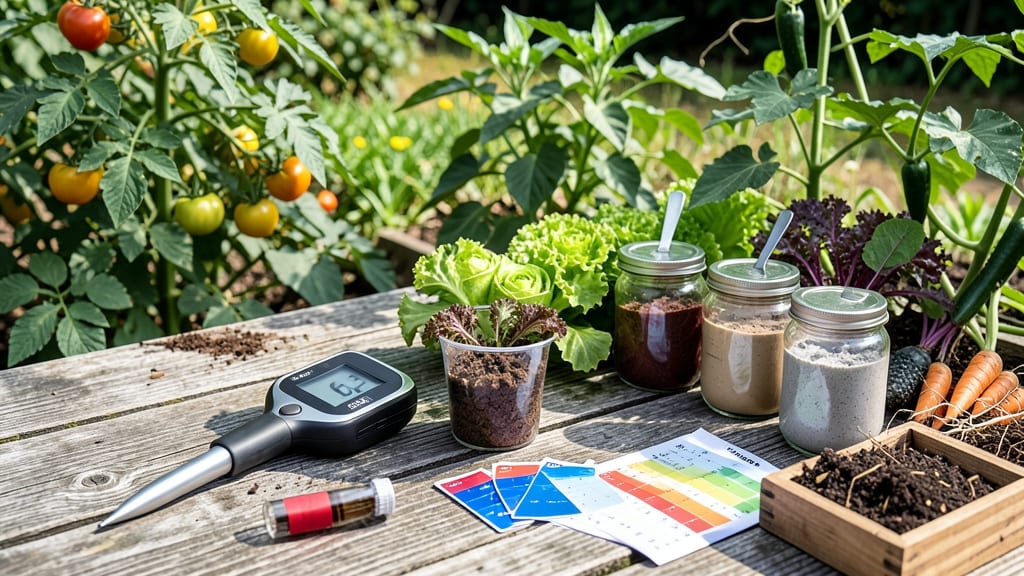
The pH level for garden vegetables should generally stay between 6.0 and 7.0, but individual plants have unique preferences—tomatoes and peppers prefer slightly acidic soil (5.5–6.8), while leafy greens like spinach and kale thrive in neutral to mildly alkaline conditions (6.5–7.5). Regular pH testing helps you fine-tune your soil for healthier plants.
Soil pH directly impacts which nutrients your vegetables can absorb.
For example, tomatoes need more acidic soil to access phosphorus, while beans struggle in acidic conditions because they rely on calcium and magnesium. 🌱 Testing your soil with a simple pH kit (available at garden centers) costs just a few dollars and can save you from wasted effort.
Most gardeners adjust pH gradually—adding sulfur to lower it or lime to raise it—while monitoring plant health over weeks rather than days.
Don't forget that organic matter like compost naturally buffers pH swings, making your adjustments more stable. I've found that raising beds gives me better control over pH than in-ground planting, especially in areas with naturally alkaline soil.
The key is patience: drastic changes can harm roots, so aim for 0.5–1.0 pH point shifts per season.
💡 In This Article
- How Soil pH Affects Vegetable Nutrient Absorption
- Adjusting Soil pH for Different Vegetable Types
How soil pH affects vegetable nutrient absorption
Soil pH acts like a gatekeeper for nutrients—it determines whether your plants can access the essential elements they need to grow. At a pH of 6.0–7.0, most vegetables can absorb nutrients efficiently because this range keeps phosphorus, potassium, and nitrogen in their most available forms.
For example, phosphorus—critical for root development and flowering—becomes locked away in alkaline soils above pH 7.5, starving crops like tomatoes and peppers. 🌱 Meanwhile, iron and manganese, vital for chlorophyll production, become unavailable in alkaline conditions, leading to yellowing leaves even when soil looks fertile.
The science gets even more precise when you look at micronutrients. Zinc and copper, needed in tiny amounts but crucial for enzyme function, are most available in acidic soils (pH 5.5–6.5). This is why blueberries and potatoes—both acid-loving plants—thrive in slightly acidic conditions.
Conversely, calcium and magnesium, which prevent blossom-end rot in tomatoes and leaf curl in beans, become more soluble in neutral to slightly alkaline soils (pH 6.5–7.5). The balance is delicate: a 0.5 pH shift can make the difference between lush growth and stunted, yellowing plants.
Root development is another area where pH plays a hidden role. Acidic soils (pH < 6.0) can damage fine root hairs, reducing a plant's ability to absorb water and nutrients.
I’ve noticed this firsthand with carrots—when soil pH drops below 5.5, their roots become gnarled and forked instead of straight and crisp. On the other hand, overly alkaline soils (> pH 8.0) can cause nutrient toxicity, as aluminum and manganese—normally inert—become soluble and accumulate to harmful levels.
This is why leafy greens like spinach and Swiss chard often wilt or develop brown edges in high-pH soils.
Disease resistance also hinges on pH balance. Fungal pathogens like Phytophthora (which causes root rot) thrive in acidic soils, while bacterial diseases such as Erwinia (which causes soft rot) are more common in alkaline conditions.
For instance, peppers—already prone to bacterial spot—suffer more in soils with a pH above 7.0. The connection isn’t just about the plants; beneficial soil microbes, like mycorrhizal fungi, also have pH preferences.
These fungi form symbiotic relationships with roots, enhancing nutrient uptake, but they struggle to colonize in soils outside their ideal pH 6.0–7.0 range.
Here’s a practical example: if your soil tests at pH 8.0 and you’re growing tomatoes, phosphorus becomes nearly inaccessible, even if you’ve added fertilizer. The plants may show signs of deficiency—purple stems, stunted growth—while the soil lab report shows "adequate phosphorus." This mismatch is why pH testing is non-negotiable.
A simple $10 kit from your local garden center can reveal whether your soil is secretly sabotaging your harvest. 💡 The fix isn’t always adding more fertilizer; sometimes, it’s adjusting the pH to unlock what’s already there.
Let’s break down the nutrient availability by pH range for clarity:
- Acidic (pH 5.5–6.5): Best for phosphorus, iron, manganese, and zinc. Ideal for blueberries, potatoes, and peppers.
- Neutral (pH 6.5–7.5): Balanced for nitrogen, potassium, calcium, and magnesium. Perfect for tomatoes, beans, and leafy greens.
- Alkaline (> pH 7.5): Locks out phosphorus and micronutrients; increases risk of toxicity for aluminum and manganese.