
Pests
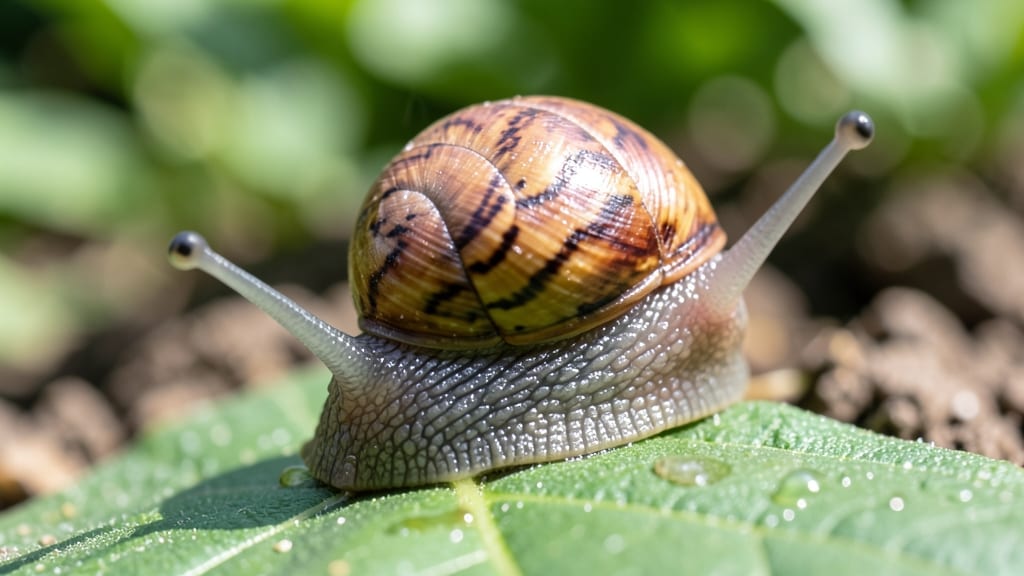
Understanding garden snail anatomy reveals their spiral shell for protection, muscular foot for movement, retractable head with sensory tentacles, and radula for scraping plant surfaces. Their soft bodies contain a mantle, lung cavity, and specialized digestive system perfect for their plant-based diet.
Garden snails have evolved some fascinating adaptations that make them both resilient and vulnerable.
Their spiral shell isn't just for show—it acts as a protective fortress they can retreat into when threatened, while their muscular foot secretes mucus for both movement and chemical communication. 🐌 The two pairs of tentacles (longer for vision, shorter for touch) help them navigate at night, and that tiny but powerful radula (a toothed tongue) lets them scrape away at leaves with surprising efficiency.
What's interesting is how their anatomy reflects their behavior: the lung cavity allows them to breathe air, and their digestive system is perfectly tuned for breaking down tough plant fibers.
These features aren't just biological curiosities—they directly impact how gardeners can control snail populations. For example, their reliance on slime trails makes them easier to spot at night with flashlights, while their soft bodies make them susceptible to natural barriers like crushed eggshells or copper tape.
Understanding these anatomical details helps explain why traditional methods like beer traps work (they're attracted to the scent) and why some organic solutions target their feeding habits rather than their shells.
💡 In This Article
- How Garden Snail Body Parts Enable Survival and Feeding
- Identifying Key Snail Parts to Spot and Control Garden Pests
How garden snail body parts enable survival and feeding
The spiral shell of a garden snail is its primary defense mechanism, acting like a portable fortress. Made primarily of calcium carbonate, this coiled structure can weigh up to one-third of the snail's total body weight—a significant investment for protection.
The shell's tight spiral design minimizes surface area while maximizing strength, making it difficult for predators like birds or beetles to crack open.
When threatened, the snail retracts its entire body inside, sealing the opening with a mucus plug that hardens into a temporary barrier. 🔥 This adaptation explains why snails are most active at night when predators are less active and why they seek shelter during the day.
The muscular foot is another marvel of snail anatomy, designed for both movement and survival. Covered in thousands of tiny cilia, this flat, oval-shaped appendage secretes mucus (up to 0.5 milliliters per hour) to reduce friction and create a slippery path.
The foot's hemipenal organs (located at its base) also play a role in reproduction, but its primary function is locomotion.
Snails move in a wave-like motion, pulling their bodies forward while leaving behind the distinctive silver slime trail—a chemical cocktail that contains glycoproteins to lubricate movement and pheromones to communicate with other snails. This slime also helps them detect vibrations, acting like a primitive sensory system.
The radula, often called the "snail's tongue," is a ribbon-like structure lined with thousands of tiny teeth (up to 14,000 per row in some species). These teeth are made of chitin, the same material as insect exoskeletons, and are arranged in rows that interlock like a saw blade.
When the snail scrapes against a leaf, the radula moves back and forth at a rate of 1-2 cycles per second, effectively "filing" away at plant tissue.
This mechanical advantage allows them to consume up to 500 times their body weight in plants annually—a critical adaptation for their herbivorous diet. The radula's efficiency also explains why snails can devour entire lettuce leaves or young seedlings overnight.
Above the mouth sits the head, equipped with two pairs of sensory tentacles. The longer pair contains eyespots (not true eyes) that detect light and movement, while the shorter pair is covered in chemoreceptors to sense smells and touch.
These tentacles are highly retractable—snails can pull them in instantly if disturbed, which is why you might see a snail's head disappear into its shell in milliseconds. The lung cavity, located just behind the head, allows them to breathe air, making them terrestrial gastropods (unlike their aquatic cousins).
This adaptation is crucial for their survival in garden environments, where they need to extract oxygen from the air rather than water.
The mantle, a fold of tissue that lines the shell's interior, plays multiple roles. It secretes the shell itself (adding new layers as the snail grows) and contains the lung, which expands and contracts to facilitate breathing.
The mantle also produces the mucus for the foot and helps regulate moisture levels, preventing the snail from drying out—a critical function in dry conditions.
Together, these anatomical features create a highly efficient system for survival: the shell protects, the foot moves, the radula feeds, and the tentacles sense, all while the mantle maintains homeostasis. 💫
Understanding these functions reveals why garden snails are such persistent pests. Their nocturnal behavior (driven by their light-sensitive eyespots) means they avoid predators and gardeners during the day.
Their radula's scraping power allows them to overcome physical barriers like thin plant stems, while their slime trails make them hard to track during daylight hours. Even their shell's calcium content makes them resistant to many chemical deterrents, as the shell absorbs and neutralizes some treatments.
This anatomical resilience explains why traditional methods like salt or vinegar often fail—snails have evolved to overcome such challenges.