
Advice
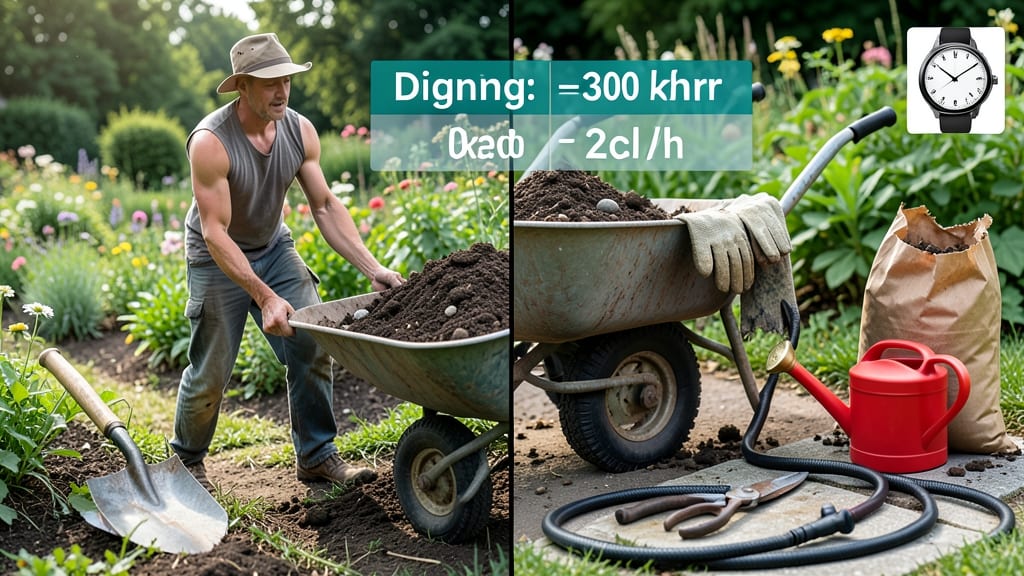
Gardening burns between 150–400+ calories per hour, depending on activity intensity and body weight—light tasks like weeding (150–250) vs heavy labor like digging (300–450+). A 155-pound person may burn ~200–350 calories in an hour of moderate gardening, while heavier individuals or vigorous work (e.g., hauling soil) can exceed 400 calories.
Your calorie burn in gardening depends heavily on the type of work you're doing and how much you weigh. 🌱 For example, pushing a lawnmower or carrying heavy pots can push you into the higher end of that range, while simply picking flowers or light pruning will keep you closer to the lower end.
What's interesting is that even "light" gardening can add up over time—think of it as a low-impact workout that still gets your heart rate up through consistent movement.
Body weight plays a surprisingly big role too. A heavier person will naturally burn more calories doing the same tasks because their muscles are working harder to move their mass.
That's why someone who weighs 200 pounds might torch 450+ calories digging, while a 130-pound person doing the same work might only hit 300. The key is finding activities that match your fitness level while still challenging your muscles.
💡 In This Article
- How Gardening Activities Impact Calorie Burn Rates
- Maximizing Calorie Burn While Gardening: Techniques and Tools
How gardening activities impact calorie burn rates
Gardening isn't just a hobby—it's a workout that engages multiple muscle groups simultaneously. The calorie burn varies dramatically based on the specific task. For instance, raking leaves for an hour burns roughly 200–280 calories for a 155-pound person, thanks to the repetitive arm and core movements.
Meanwhile, digging—which requires bending, lifting, and twisting—can torch 300–450 calories in the same time frame because it demands more strength and stability from your legs, back, and shoulders. 🌿 Even seemingly passive tasks like watering plants (if done with a heavy hose or carrying water) contribute to your total, adding 150–220 calories per hour.
The science behind these differences lies in how each activity taxes your muscles and cardiovascular system. Digging, for example, activates fast-twitch muscle fibers in your legs and core, similar to how squats or lunges work in a gym. These fibers require more energy, which translates to higher calorie expenditure.
Meanwhile, tasks like pruning (which involves fine motor skills and light arm movements) rely more on slow-twitch fibers, burning fewer calories but still offering benefits like improved hand-eye coordination and endurance.
Even mowing the lawn—often overlooked as a gardening task—can burn 250–350 calories per hour due to the continuous motion of pushing or pulling the mower, which engages your arms, legs, and core in a rhythmic pattern.
Your body weight is another critical factor. A 200-pound individual digging for an hour might burn 450–550 calories, while a 130-pound person doing the same work would burn closer to 250–350 calories.
This isn’t just about muscle mass—it’s about how much effort your body expends to move your entire frame. For example, lifting a 20-pound bag of soil repeatedly (a common gardening task) can add 50–100 extra calories per hour compared to lighter tasks like trimming hedges.
If you’re looking to maximize calorie burn, focus on activities that involve lifting, pulling, or pushing—like hauling mulch or moving garden beds—rather than just bending or reaching.
Duration also plays a role, but intensity matters more. A 30-minute session of vigorous digging (with short breaks) might burn 200–250 calories, while a 60-minute session of light weeding could burn 150–200 calories.
The key is to combine tasks—alternate between high-impact activities (like tilling soil) and moderate ones (like planting flowers) to keep your heart rate elevated and your muscles engaged throughout.
This approach mimics the structure of a circuit workout, where you alternate between strength and cardio exercises for optimal calorie burn.
What most people don’t realize is how gardening tools can amplify or reduce calorie expenditure. Using a manual lawnmower (which requires pushing) burns more calories than a self-propelled model, simply because you’re engaging more muscles.
Similarly, shovels with longer handles force you to use your entire arm and shoulder, increasing energy output compared to shorter-handled tools. Even the weight of your watering can matters—opt for a 5-gallon metal can over a lightweight plastic one to add resistance to your movements.
These small tweaks can turn a leisurely garden session into an effective workout without feeling like one. 💪
For a real-world example, imagine spending two hours in the garden: 30 minutes digging, 30 minutes raking, and 30 minutes planting. A 155-pound person could burn 500–700 calories in that time, depending on the intensity.
That’s comparable to a moderate jog or a spin class—but with the added bonus of fresh air, sunlight, and a productive outcome. The beauty of gardening as exercise is that it’s scalable: you can adjust the difficulty by choosing heavier tools, tackling bigger projects, or simply working longer.
It’s one of the few activities where you can control the intensity while still enjoying the process.