
Tools
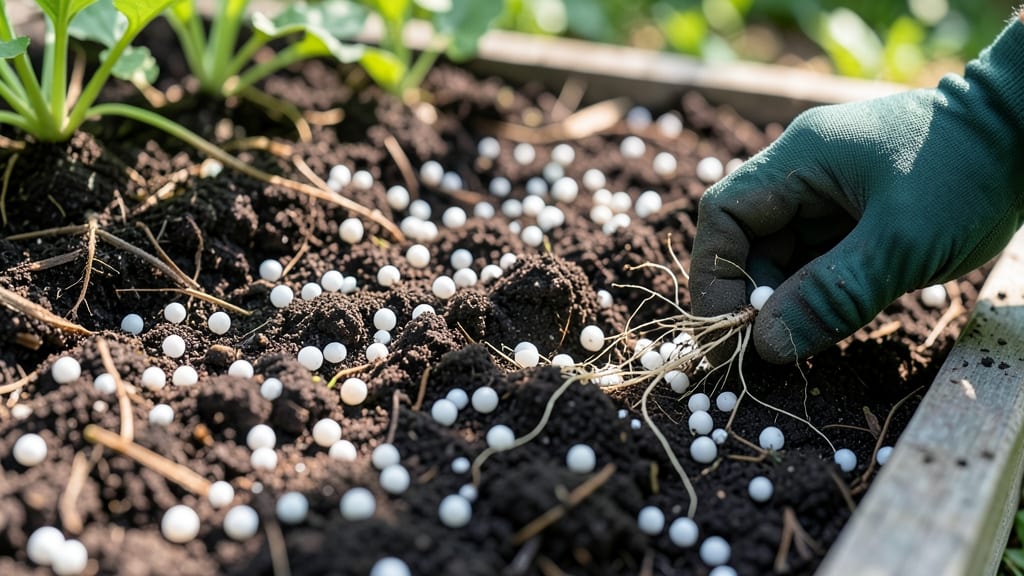
When you spot white balls in garden soil, they're usually harmless gypsum deposits, lime buildup, or insect casings like ant mounds, though they can hint at drainage or soil pH problems. Always check what you're dealing with first before deciding whether to remove them or fix the underlying issue.
These mysterious white spheres often form from natural mineral processes or critter activity.
Gypsum crystals appear when calcium sulfate combines with water, especially in alkaline soils, while lime nodules develop from excess calcium carbonate. 🌱 Insect casings, like ant mounds, are simply discarded shells—but their presence might signal poor drainage if they're clustered in damp areas.
The key is to test your soil pH first: if it's above 7.5, you're likely dealing with lime buildup that could benefit from organic amendments like sulfur or composted pine needles.
Never assume all white balls are harmless. If they're hard and crumbly (like gypsum), they won't hurt plants but may indicate over-fertilization with calcium. Soft, porous casings suggest insect activity that could damage roots if left unchecked.
For removal, use a small trowel to gently lift insect mounds—never disturb them during active seasons when you might harm beneficial insects. When in doubt, take a sample to your local extension office for professional analysis.
💡 In This Article
- Identifying Common Causes of White Balls in Soil
- Safe Removal and Soil Correction Methods
Identifying common causes of white balls in soil
Gypsum deposits form when calcium sulfate combines with water in alkaline soils, creating those distinctive white, chalky spheres.
This mineral appears most commonly in dry climates where evaporation rates exceed precipitation, causing dissolved minerals to crystallize at the surface. 🌱 The process begins when water dissolves calcium sulfate from parent rock or fertilizer, then evaporates, leaving behind gypsum crystals that can range from 1/8-inch to 1-inch in diameter.
These deposits are completely inert—they won't harm plants directly but may indicate over-application of calcium-rich amendments.
Lime nodules develop from excess calcium carbonate, typically in soils with a pH above 7.5. These white, powdery clumps form when calcium reacts with bicarbonate ions in alkaline conditions, creating insoluble calcium carbonate that precipitates out.
The texture is often softer than gypsum, almost like crushed seashells, and they'll fizz when exposed to vinegar—a simple test to distinguish them from other deposits. 🔍 This buildup can restrict root growth by compacting soil structure, though it's rarely toxic unless present in extreme concentrations.
Insect casings, like those from ants or termites, are the third common culprit. Worker ants discard their shed exoskeletons (called "molt") as white, papery balls that accumulate near nest entrances.
These casings are typically 1/4-inch to 1/2-inch in diameter and have a delicate, almost translucent quality when fresh. 🐜 While the casings themselves won't harm plants, their presence may indicate poor drainage if they're concentrated in waterlogged areas, as many mound-building insects prefer moist conditions.
Distinguishing between these causes starts with a simple visual and tactile inspection. Gypsum feels gritty and dissolves slowly in water, while lime nodules crumble into a fine powder. Insect casings, meanwhile, often have faint segmentation patterns from the original exoskeleton.
For definitive identification, conduct a pH test—alkaline soils (pH 7.5+) strongly suggest lime, while neutral or acidic soils point toward gypsum or insect activity.
Soil moisture plays a critical role in formation. Gypsum thrives in dry conditions where evaporation accelerates mineral precipitation, while lime nodules form in consistently moist alkaline soils. Insect casings, however, appear year-round but become more visible after rainfall when nests are active.
This seasonal pattern helps narrow down the source—if you spot white balls after dry spells, gypsum is likely; after wet periods, consider insects or lime.
One often-overlooked clue is location. Gypsum typically appears in topsoil layers where evaporation is highest, while lime nodules often form deeper in the profile where calcium accumulates. Insect casings, however, are almost always found near surface disturbances or along garden paths where ants travel.
These spatial patterns provide valuable context for determining whether the white balls are a natural mineral process or a sign of biological activity needing attention.