
Container Gardens
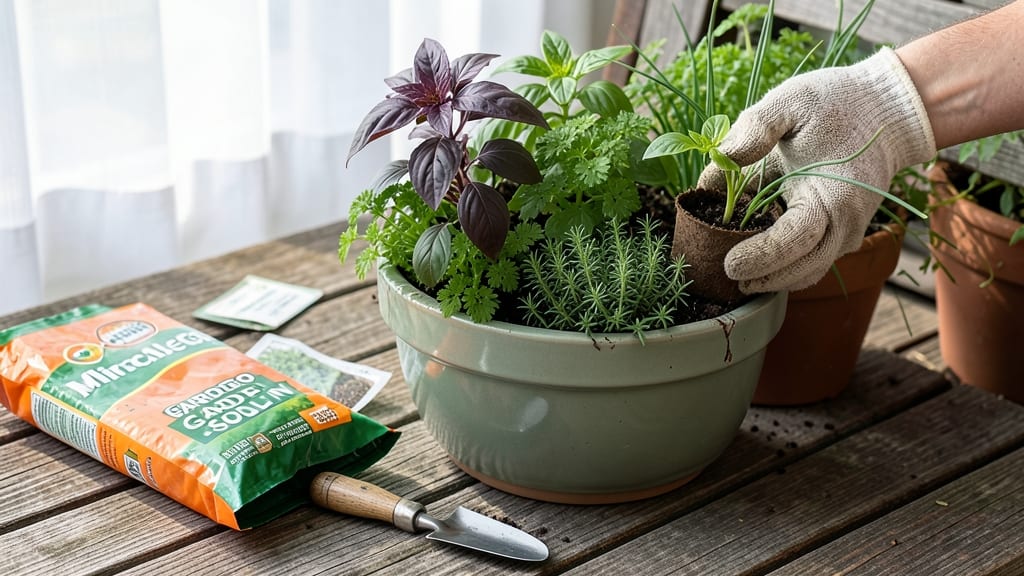
You can use Miracle-Gro Garden Soil in pots, but it needs modification to prevent root suffocation: blend it 50/50 with perlite, sand, or coconut coir for better airflow, and always include a drainage layer at the container's bottom.
Miracle-Gro Garden Soil is formulated for in-ground planting, where natural soil structure helps manage moisture and aeration.
In containers, though, its dense composition can trap water and block oxygen flow to roots. 🌱 I've found that adding coarse materials like perlite or sand creates air pockets, while a gravel base prevents waterlogging.
For example, a 50/50 mix works well for most plants, but succulents may need even more gritty amendments to thrive.
Another key factor is pot size—smaller containers dry out faster, so you might adjust the mix ratio to retain slightly more moisture. Always check your plants' specific needs; ferns and calatheas, for instance, benefit from the extra moisture retention, while cacti and herbs need that gritty blend to prevent rot.
💡 In This Article
- Why Miracle-Gro Garden Soil Needs Modification for Containers
- Best Mix Ratios for Potted Plants with Miracle-Gro Soil
Why Miracle-gro garden soil needs modification for containers
Miracle-Gro Garden Soil is designed for in-ground planting where natural soil structure helps regulate moisture and aeration. In containers, however, its dense composition creates a compacted environment that suffocates roots.
This happens because the soil's high organic matter content (about 40-50%) breaks down quickly, creating a heavy, clay-like texture that blocks oxygen flow. 🌱 Roots need both air and water—without proper aeration, they can't absorb nutrients efficiently, leading to stunted growth or rot.
The problem stems from how water behaves in dense soil. When you water potted plants, the compacted mixture holds moisture too tightly near the roots, creating anaerobic conditions (low oxygen). This forces roots to work harder just to breathe, while also promoting harmful bacteria and fungi.
Studies show that container soils should maintain 10-30% air porosity—Miracle-Gro's standard mix often falls below 10% without amendments. Adding perlite or sand increases this porosity to 25-30%, creating the ideal balance.
Consider how this affects your plants' health: Without proper aeration, roots can't develop properly, leading to weak stems and yellowing leaves. I've noticed this most dramatically with ferns and calatheas, which thrive in consistently moist but well-aerated conditions.
The dense soil also makes it harder for water to drain evenly, creating pockets where moisture lingers—perfect conditions for root rot. 💧 A simple drainage layer at the pot's base (like 1-2 inches of gravel or broken pottery shards) solves this by preventing water from pooling at the roots.
Another critical factor is the soil's pH balance. Miracle-Gro's formula is slightly acidic (pH 5.8-6.2), which works well for in-ground planting but can become problematic in containers where pH levels fluctuate more easily.
Without proper aeration, organic matter breaks down faster, releasing acids that lower the pH even more—sometimes dropping below 5.0, which stresses many common potted plants like basil or petunias. Adding perlite not only improves aeration but also helps stabilize pH levels.
Let's break down what happens when you skip modifications: In a 5-gallon pot filled with unamended Miracle-Gro, water can take 3-4 days to drain completely through the soil profile, compared to 1-2 days in a properly amended mix.
This extended moisture retention creates the perfect storm for fungal issues like Pythium, which thrives in waterlogged conditions. The visual difference is striking—roots in unamended soil appear dark and mushy, while amended soil shows healthy white or light tan roots with good branching.
For container gardening, think of soil as a three-phase system: solid (soil particles), liquid (water), and gas (air). Miracle-Gro's dense formula tips this balance toward solids and liquids, crowding out the essential gas phase.
By adding 20-30% perlite or sand, you create a more balanced environment where roots can access all three components they need to thrive. This simple adjustment transforms a potentially problematic soil into a productive growing medium for containers. 🌿