
Vegetables
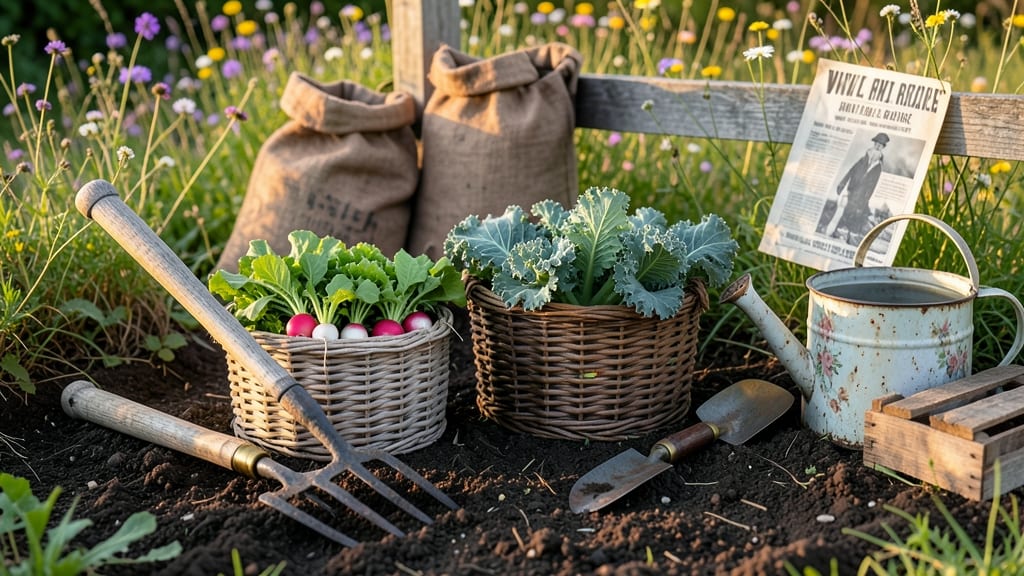
Victory gardens during World War 1 supplied over 40% of fresh produce in Britain alone by transforming private yards into productive food sources, directly supporting war efforts through homegrown vegetables and preserved goods. These community-driven plots became symbols of national resilience.
These gardens weren't just practical—they were strategic. 🌱 Governments distributed free seeds and published planting guides to maximize yields, while women and children took lead roles in maintaining them. The movement created lasting agricultural knowledge that still influences modern urban farming today.
What's fascinating is how these simple plots became both a food security measure and a morale booster during one of history's darkest periods.
At their peak, Britain had over 1.3 million victory gardens producing everything from potatoes to peas. The U.S. followed suit, with 5 million gardens supplying 40% of the nation's vegetables by 1918.
Many families preserved their harvests through canning and drying, ensuring fresh produce lasted through winter shortages. This grassroots effort proved that even small-scale farming could make a massive difference during crises.
💡 In This Article
- How WW1 Victory Gardens Revolutionized Home Food Production
- Plants and Seeds That Defined WW1 Victory Gardens
How WW1 victory gardens revolutionized home food production
Victory gardens emerged as a direct response to wartime food shortages that threatened both civilian diets and military rations. By 1917, Britain faced severe food rationing due to blockades and disrupted shipping, while the U.S. saw 20% of its agricultural workforce drafted into service.
Governments realized that transforming private yards into productive plots could free up commercial crops for export to allies and feed troops. The British government launched the "War Gardens" campaign in 1915, distributing 5 million seed packets within months—equivalent to planting 1 acre per 10 people in urban areas.
The revolution began with propaganda campaigns that framed gardening as patriotic duty. Posters showed children planting carrots with slogans like "Grow Your Bit," while women—who managed households during men's absences—became the movement's backbone.
Urban spaces like London rooftops and New York vacant lots were converted into plots using simple techniques: raised beds for poor soil, compost from household scraps, and crop rotation to prevent disease.
The U.S. Department of Agriculture even published free planting guides with charts showing which vegetables to grow based on climate zones, ensuring maximum yields with minimal space.
What made these gardens uniquely effective was their community-driven structure. Neighbors shared tools and seeds, while local schools taught children basic horticulture. In Britain, the Women's Land Army recruited 280,000 women to work on larger plots, proving that large-scale food production wasn't limited to farms.
The psychological impact was equally significant: families who grew their own food experienced less anxiety about shortages and gained a sense of control during chaotic times. This collective effort created a self-sufficiency mindset that persisted long after the war.
The scientific approach to these gardens was surprisingly modern. Agronomists advised planting high-calorie, nutrient-dense crops like potatoes (which could store for months) and cabbage (hardy in cool climates). Seed-saving techniques were emphasized to reduce reliance on commercial suppliers.
For example, the National War Garden Commission in the U.S. recommended saving seeds from the hardiest plants to replant the next season—a practice still used by organic farmers today.
Even urban dwellers with just 100 square feet could grow enough to supplement rations, proving that scale didn't matter as much as intention.
One lesser-known innovation was the use of alternative growing spaces. In cities like Berlin, families cultivated vegetables in window boxes and hanging baskets, while British households grew sprouts in jars on kitchen counters.
These methods ensured that even those without yards could contribute. The movement also introduced intercropping—planting fast-growing radishes alongside slower carrots—to maximize space efficiency. This technique is now a cornerstone of modern square-foot gardening.
The legacy of WW1 victory gardens extends beyond wartime. They demonstrated that food security could be decentralized, a principle that resonates today with urban farming movements.
The 40% of Britain's vegetables produced in these gardens during the war would be equivalent to 12 million tons of produce today—enough to feed millions. What started as a desperate measure became a blueprint for resilience that still inspires gardeners worldwide. 🌱