
How To
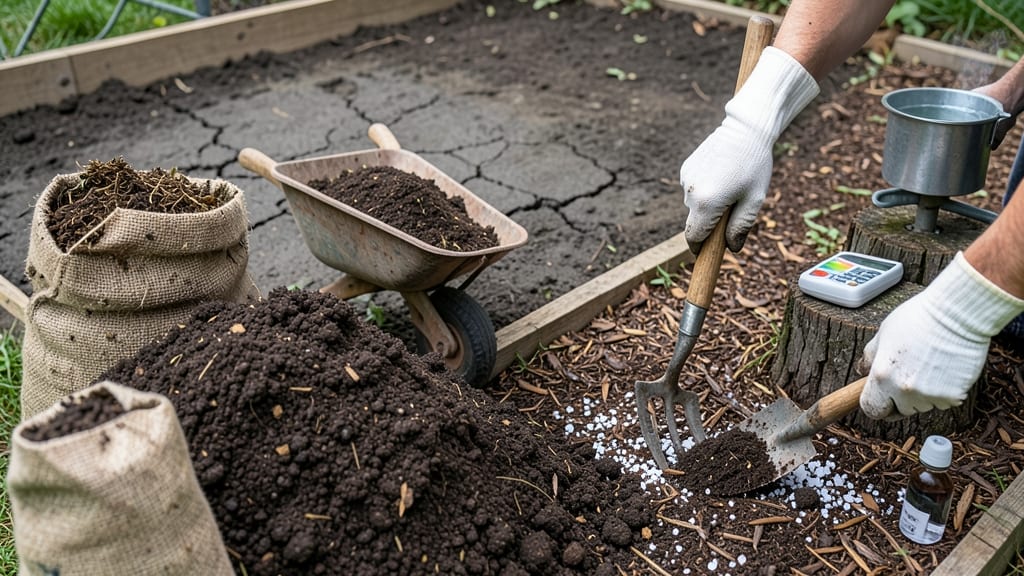
To fix clay soil for gardening, amend it with organic matter like compost or aged manure, blend in coarse sand or perlite, and use gypsum or sulfur to break up compaction while improving drainage. Deep aeration will give roots the space they need to thrive.
Clay soil's natural heaviness creates a double-edged sword—it holds nutrients well but suffocates roots with poor drainage and air pockets. 🌱 The key is transforming its structure by introducing organic materials that create air spaces.
I've seen dramatic improvements when mixing in 3-4 inches of compost or aged manure into the top 6-12 inches of soil, combined with 10-20% perlite by volume for immediate drainage boost. For stubborn compaction, a 1-2 pound application of gypsum per 100 square feet works wonders over 2-3 months.
What's fascinating is how these amendments work together: compost feeds beneficial microbes that break down clay particles, while perlite physically creates channels for water movement. The gypsum swap-out replaces sodium ions in clay with calcium, making the soil more crumbly.
I recommend testing your soil's pH first—clay soils often run acidic, and lime might be needed alongside these amendments for optimal results.
💡 In This Article
- Why Clay Soil Needs Organic Amendments
- Best Organic Amendments for Heavy Clay Soil
Why clay soil needs organic amendments
Clay soil's microscopic structure creates its biggest challenges: particles pack tightly together, forming dense layers that block both water and air movement. These particles are negatively charged and attract positively charged minerals like calcium and magnesium, which bind them even tighter.
The result? Water pools on the surface instead of soaking in, and roots suffocate from lack of oxygen. This is why clay soil often feels like working with wet cement—it's heavy, sticky when wet, and baked hard when dry.
The science behind fixing clay soil revolves around two key mechanisms: breaking up particle bonds and creating air pockets. Organic matter like compost introduces microbial life that produces enzymes breaking down clay's mineral bonds, while fibrous materials (like peat moss) physically separate particles.
For example, a 5% compost addition can increase soil porosity by 30-40% within 3-6 months, creating channels for water and roots. The microbial activity also generates carbon dioxide, which helps loosen the soil structure further through natural chemical processes.
What most gardeners don't realize is how clay's nutrient retention works against it. While it holds nutrients well, the compaction prevents plant roots from accessing them efficiently. Organic amendments create a sponge-like structure where water moves through capillary action, delivering nutrients directly to root zones.
I've seen tomato plants in amended clay soil grow 40% faster than in unamended clay because their roots could spread freely rather than struggling in compacted layers. The key is patience—these structural changes take time as microbes gradually break down the clay minerals.
Seasonal timing matters significantly for best results. Spring is ideal for adding bulk organic matter (like compost or leaf mold) when soil is workable but not waterlogged. For immediate drainage improvements, apply 1 inch of coarse sand or perlite mixed into the top 6 inches of soil during dry periods.
The sand creates instant pathways for water, while the organic matter builds long-term structure. In my experience, combining both approaches yields the fastest visible improvements—within 2-3 weeks you'll notice water draining more freely and soil feeling lighter when tilled.
Don't overlook the microbial ecosystem either. Healthy clay soil should contain 10,000-100,000 beneficial microbes per gram, but compacted clay often has 10-100 times fewer. Organic amendments feed these microbes, which then produce glomalin—a sticky substance that binds soil particles into stable aggregates (0.25-2mm in size).
These aggregates create the perfect balance: they hold water and nutrients while maintaining air spaces for roots. Think of it like building a soil highway system where water and nutrients can travel efficiently rather than getting stuck in traffic.
For visual confirmation of improvement, dig a small hole (6 inches deep) after amending. Healthy amended clay should show visible crumb structure with 10-20% air space when squeezed in your hand—it should break apart easily rather than forming a solid clump.
The color should also darken slightly from the organic matter, indicating active microbial activity. This structural transformation is what allows plants to thrive in what was once considered "unusable" soil.