
Plants
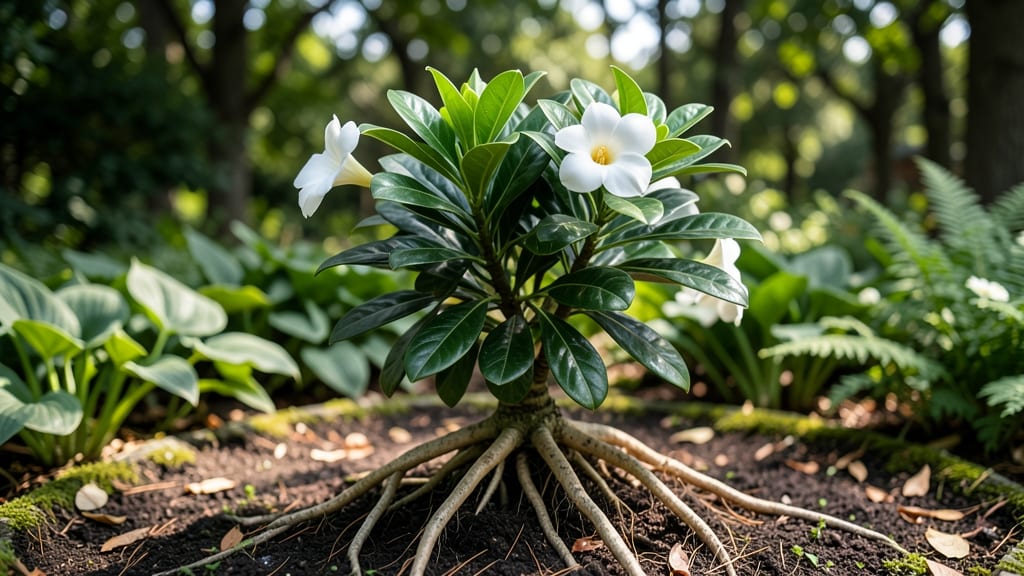
A gardenia root system spreads shallowly but aggressively, forming dense fibrous roots that anchor the plant while competing for moisture and nutrients. Its shallow depth makes it vulnerable to drought but thrives in well-draining, slightly acidic soil with consistent humidity.
A gardenia's underground network is all about efficiency—its fibrous roots spread horizontally just beneath the soil surface, creating a dense mat that holds the plant securely. 🌱 These roots prioritize water and nutrient absorption, which is why they react quickly to changes in soil moisture.
Unlike deep taproots, gardenias rely on their lateral spread to establish dominance in their growing space, often extending up to 3 feet wide for mature plants. This shallow structure also means they're highly sensitive to soil compaction or poor drainage, which can suffocate the roots and lead to decline.
What makes this root system particularly interesting is its relationship with soil microbes. Gardenias form beneficial partnerships with mycorrhizal fungi, which extend their reach even further, helping them access nutrients beyond their physical range.
This symbiotic relationship explains why gardenias often thrive in nutrient-poor but well-aerated soils—nature's own nutrient delivery system at work.
💡 In This Article
- Gardenia Root System Anatomy and Growth Patterns
- Optimal Soil and Care for Healthy Gardenia Roots
Gardenia root system anatomy and growth patterns
The gardenia root system is a masterclass in efficiency, designed to maximize nutrient and water uptake with minimal energy. Unlike many flowering plants that develop a single dominant taproot, gardenias produce a dense network of fibrous roots that spread horizontally just beneath the soil surface.
These roots typically grow within the top 6-12 inches of soil, creating a sprawling mat that can extend 3-5 feet wide in mature plants.
This shallow but expansive structure allows gardenias to rapidly absorb moisture and nutrients from large surface areas, similar to how a wide net captures more fish than a narrow spear.
What sets gardenia roots apart is their incredible adaptability to soil conditions. In well-draining, slightly acidic soils (pH 5.0-6.5), these roots develop a highly branched structure that increases surface area for water absorption.
The root tips are particularly sensitive to moisture gradients, growing toward damp areas while avoiding waterlogged zones. This is why gardenias often struggle in heavy clay soils—the roots can't penetrate compacted layers, leading to suffocation and rot.
The fibrous nature also makes them vulnerable to physical disturbance, which is why careful transplantation is crucial.
At the microscopic level, gardenia roots form symbiotic relationships with mycorrhizal fungi, microscopic organisms that colonize the root surface. These fungi create an extended network that can reach 10-20 times farther than the plant's physical roots, effectively acting as the plant's underground hunting party.
The fungi absorb nutrients like phosphorus and nitrogen from the soil and exchange them for carbohydrates produced by the gardenia through photosynthesis. This partnership explains why gardenias often thrive in nutrient-poor soils—they're not picky eaters when they've got a fungal food delivery service.
The root system's shallow nature also makes gardenias particularly sensitive to temperature fluctuations. During winter, roots can become dormant but remain active in warmer climates year-round. In colder regions, gardenias often need protection from freezing temperatures, which can damage the delicate root structure.
Interestingly, gardenia roots produce root exudates—natural chemical secretions that alter the soil microbiome around them, creating a more hospitable environment. These exudates can even suppress certain soil pathogens, giving gardenias a natural defense mechanism against root diseases.
One fascinating adaptation is how gardenia roots respond to drought conditions. When moisture becomes scarce, the roots prioritize water conservation by reducing their surface area and thickening their cell walls. This creates a more drought-resistant structure, but it also means gardenias can't tolerate prolonged dry spells.
The fibrous nature makes them particularly susceptible to wilting when soil moisture drops below 30-40% capacity, which is why consistent watering is essential for these tropical plants.
Understanding this root anatomy helps explain why gardenias often struggle in improperly amended soil. Their shallow spread means they're highly sensitive to soil compaction, poor drainage, or excessive organic matter that can suffocate them.
The key to successful cultivation lies in replicating their natural growing conditions—light, airy, and consistently moist—but never waterlogged soil that mimics their native tropical environments.