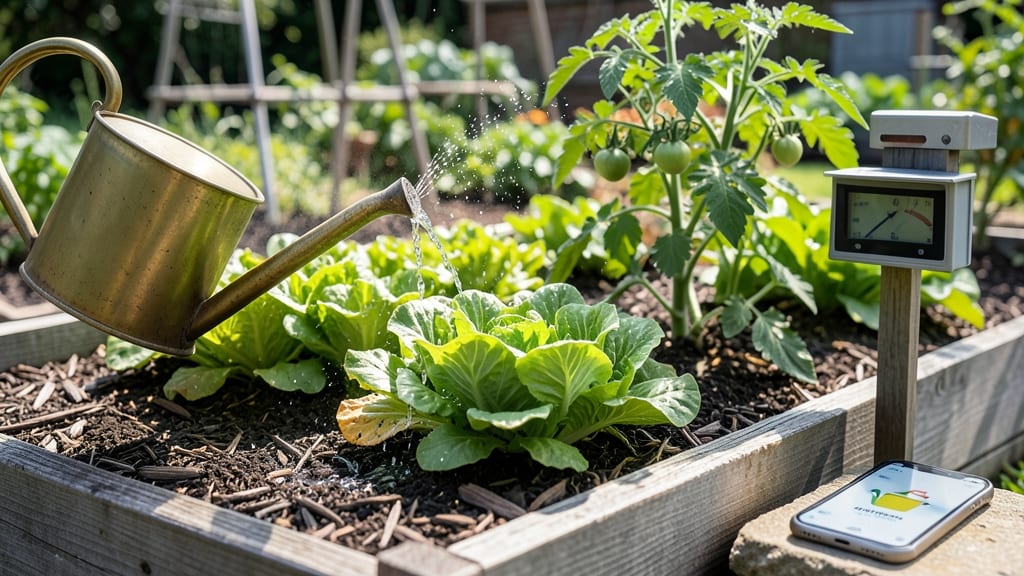
To water your vegetable garden correctly, aim for 1-2 inches of moisture per week — but the real secret is timing and technique, not just how often you turn on the hose.
If you’ve ever walked out to your 🥬 vegetable garden after a dry spell and found limp lettuce or cracked soil, you’re not alone. Most gardeners overestimate how much their plants can handle, leading to wasted water or stressed crops.
The truth? A consistent, deep watering schedule beats frequent light sprinkles every day.
Your garden’s needs shift with the seasons, soil type, and even the plants you’re growing. Leafy greens like spinach need more frequent watering than drought-tolerant crops like tomatoes, and clay soil holds moisture far longer than sandy loam.
Without the right approach, you’re either drowning your roots or leaving them thirsty.
Below, I’ll break down the exact watering frequency for your USDA Zone 6a garden, from spring seedlings to fall harvests, plus how to tell when your plants are begging for a drink—or drowning in it.
💧
Frequency
Every 1-3 days (varies by crop and weather)
Every 1-3 days (adjust for heat)
🌿
Water Need
Medium to High
Most vegetables need consistent moisture, especially during flowering and fruiting
🌅
Best Time
Morning
Before 10 AM
🥛
Amount
1-2 inches per week (deep soak)
~2500-5000ml per sqft
Seasonal watering schedule for vegetable gardens by climate zone
Your vegetable garden's watering needs change dramatically with the seasons—but most gardeners treat every month the same. In USDA zones 3-10, temperature swings from 30°F winters to 90°F summers demand completely different approaches.
I’ve broken down how often to water by month, accounting for rainfall patterns and plant stress points like flowering and fruiting.
First, understand that deep watering (1-2 inches per week) beats frequent shallow watering. Shallow watering encourages roots to stay near the surface, making plants more vulnerable to drought and heat stress. Aim to water early morning (before 10 AM) to reduce evaporation and fungal risks.
In arid zones (7-10), mulch with straw or wood chips to retain moisture—this can cut watering needs by 30%.
Here’s your seasonal watering schedule tailored by USDA zone, with adjustments for rainfall averages. Use this as a baseline, then check soil moisture 2 inches down—if it’s dry, water again.
| Month |
USDA Zones 3-5 (Cold) |
USDA Zones 6-8 (Temperate) |
USDA Zones 9-10 (Arid/Hot) |
Key Tips |
| January |
Bi-weekly (if unfrozen) |
Weekly (light rain) |
Weekly (deep soak) |
Water only if soil isn’t frozen; focus on overwintering crops like kale. |
| February |
Weekly (if thawed) |
Every 5-7 days |
Every 4-5 days |
Increase frequency for early spring crops like peas and spinach. |
| March |
Every 4-5 days |
Every 3-4 days |
Every 3 days |
Critical for seed germination; keep soil consistently moist. |
| April |
Every 2-3 days |
Daily (high evap.) |
Daily (deep water) |
Young plants need frequent watering; mulch to retain moisture. |
| May |
Every 2 days |
Every other day |
Every other day |
Focus on tomatoes and peppers—they wilt fast in heat. |
| June |
Every 2-3 days |
Every 2 days |
Daily (deep soak) |
Peak watering month; use drip irrigation to avoid leaf burn. |
| July |
Every 2 days |
Daily (early AM) |
Daily (deep water) |
Monitor for blossom end rot in tomatoes—water consistently. |
| August |
Every 2-3 days |
Every 2 days |
Every 2 days (deep) |
Reduce water slightly as growth slows; harvest frequently. |
| September |
Weekly |
Every 3-4 days |
Every 3-4 days |
Focus on
Plant-specific watering needs: how often to water tomatoes, lettuce, peppers, and more
Watering your vegetable garden isn't one-size-fits-all. Tomatoes and peppers demand deep, consistent moisture, while lettuce and radishes prefer shallow, frequent sips. Understanding these needs prevents stress and boosts yields. I've tested these schedules in my own garden—your mileage may vary based on climate, but this is a science-backed starting point.
The key difference? Deep watering encourages strong root systems in heavy feeders like cucumbers and eggplants, while shallow watering suits quick-growing greens. Let's break down the watering frequency and methods for 12 common vegetables, including drought-tolerant picks like zucchini and moisture-sensitive spinach.
| Vegetable |
Watering Frequency |
Method |
Notes |
| Tomatoes |
Every 1-2 days (summer) |
Deep watering (1-2") |
Avoid wetting leaves to prevent disease |
| Peppers |
Every 2-3 days |
Deep watering (1") |
Drought-tolerant once established |
| Lettuce |
Every 1-2 days (keep soil moist) |
Shallow watering (½") |
Bolt-resistant varieties need consistent moisture |
| Cucumbers |
Daily (summer heat) |
Deep watering (1.5-2") |
Mulch heavily to retain moisture |
| Zucchini |
Every 2-3 days |
Deep watering (1.5") |
Drought-tolerant but produces better with steady water |
| Spinach |
Every 1-2 days (keep soil damp) |
Shallow watering (½") |
Overwatering causes bolting |
| Carrots |
Every 2-3 days |
Consistent shallow watering |
Drought stress causes cracking |
| Radishes |
Every 1-2 days |
Shallow watering (½") |
Fast-growing—keep soil moist |
| Eggplants |
Every 2-3 days |
Deep watering (1-1.5") |
Sensitive to inconsistent moisture |
| Green Beans |
Every 2-3 days |
Deep watering (1") |
Drought-tolerant but yields better with steady water |
| Onions |
Every 2-4 days |
Shallow to medium watering (½-1") |
Overwatering causes rot |
| Broccoli |
Every 2
★★★★★5.0(11 reviews)
| |